Architecture description
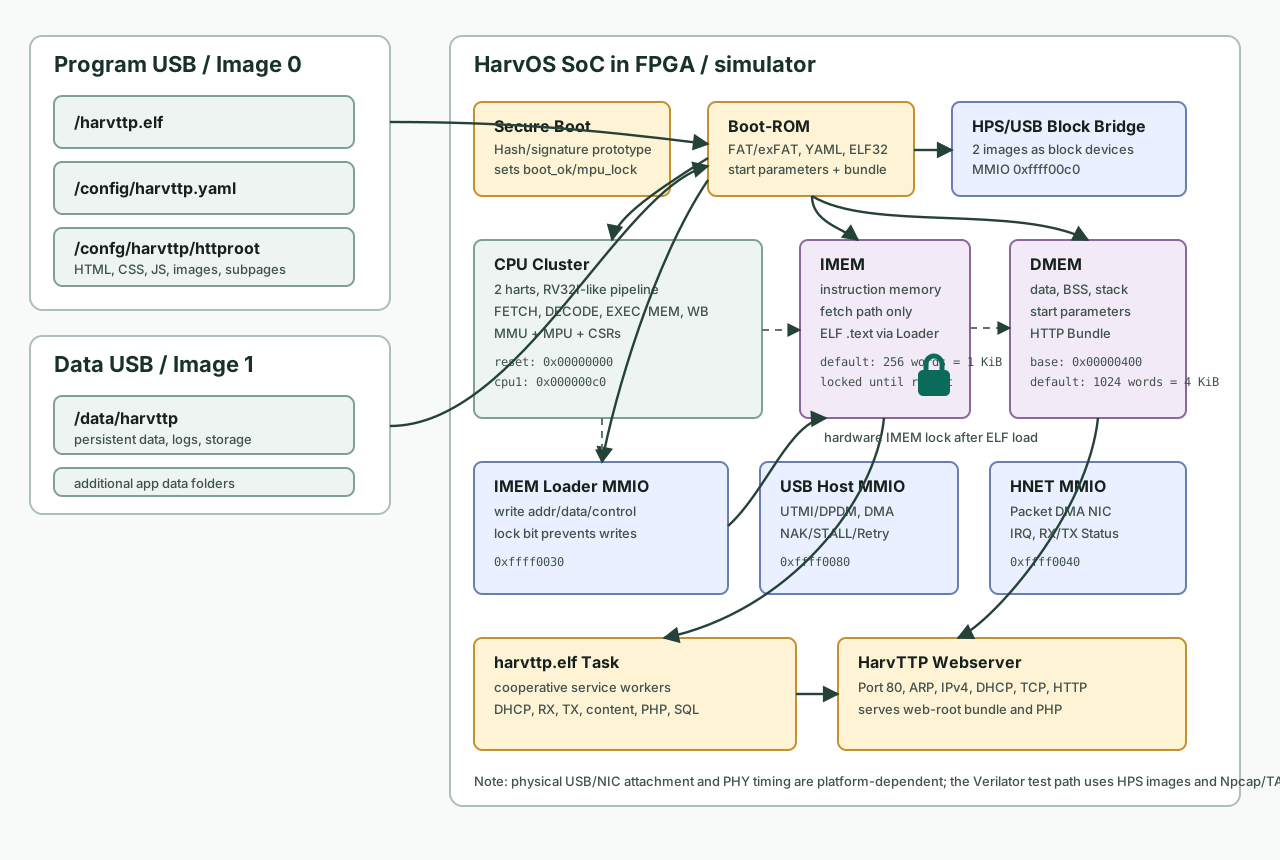
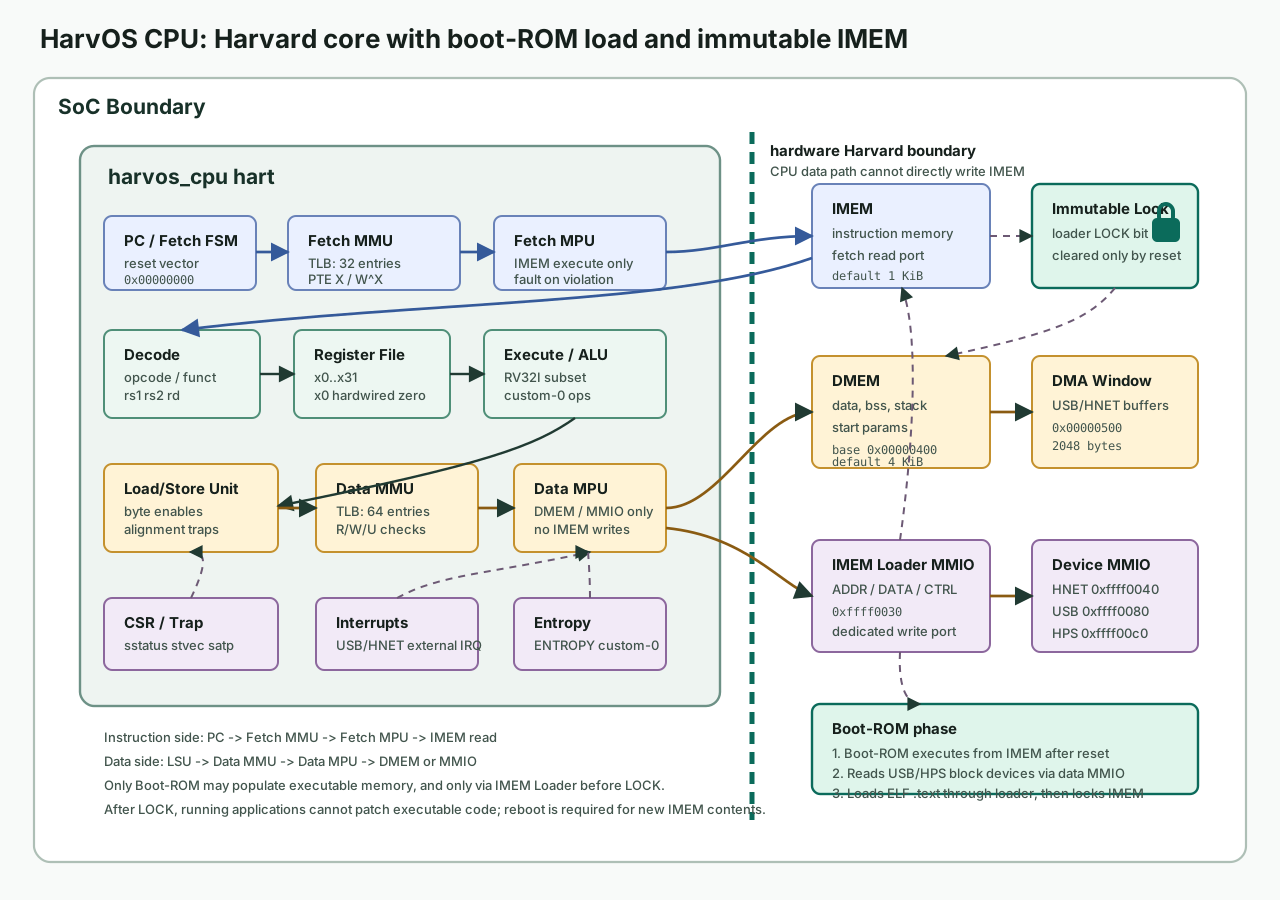
HarvOS is a small observable SoC for boot and runtime experiments. Its central design choice is a hard separation between instruction and data paths, so ELF code can be loaded into IMEM and locked by hardware.
CPU-internal view
SoC blocks
| Block | Function | Implementation state |
|---|---|---|
harvos_cpu | RV32I-like 32-bit CPU with local CSRs, HarvOS MMU/MPU, traps, fetch path and data path. | Implemented in RTL and used in Verilator tests. |
harvos_soc | Top-level integration with two CPU harts, IMEM, DMEM, MMIO, DMA IOMMU, secure boot, USB, HNET and HPS block bridge. | Implemented in RTL; the test path uses images and Npcap/TAP-style bridging. |
harvos_smp_bus2 | Arbitrated shared data bus for both CPU harts. | Active for DMEM and MMIO accesses. |
harvos_mmu | Virtual-to-physical access check with PTE-style flags and W^X enforcement. | Separate instances for fetch and data. |
harvos_mpu | Fixed physical access policy for instruction ROM/IMEM, data RAM, MMIO and lock state; not RISC-V PMP. | Enforces Harvard rules and access faults. |
harvos_imem_loader_mmio | The only legitimate write path into instruction memory during boot. | After LOCK, IMEM writes are rejected until reset. |
harvos_net_mmio | Packet-DMA network device for HarvTTP, HarvSQL and the test suite. | RX/TX, IRQ, link status and DMA window. |
harvos_usb_host_mmio | USB host MMIO with DMA, UTMI/DPDM signals, port power and retry/NAK/STALL status. | Integrated on the RTL side; mass-storage logic is software-side. |
harvos_mister_hps_block | MiSTer/HPS-compatible block access to two disk images. | Current boot-ROM test path for program and data images. |
CPU microarchitecture
The CPU is not superscalar or out-of-order. It is a deterministic multi-cycle machine. Each instruction passes through fetch, decode, execute and, when needed, memory/writeback. This keeps boot-ROM and low-level hardware debugging easy to observe.
| State | Task |
|---|---|
ST_FETCH | Check PC, handle interrupts/traps, apply fetch MMU/MPU and read the instruction word. |
ST_DECODE | Decode source and destination registers. |
ST_EXEC | ALU, branch, jump, CSR, system, Custom-0 and address calculation. |
ST_MEM | Data MMU/MPU, byte lanes, load/store and MMIO access. |
ST_WB | Write back to rd and advance the PC. |
ST_CLRMEM | Privileged block clearing through Custom-0. |
Harvard separation
The normal data path cannot write IMEM directly. Executable ELF code is loaded only by the boot ROM through the IMEM loader. Once the loader is locked, a running service can use data, BSS, stack and MMIO, but it cannot patch or load instructions.
Current boot/runtime boundary
- The SoC initializes IMEM through
$readmemhor a default ROM. - Secure boot releases
boot_ok; on failure the CPU stays in the reset path. - The boot ROM detects two images, mounts them and searches for valid ELF/YAML/data pairs.
- ELF text segments are written through the IMEM loader; data segments go to DMEM.
- The boot ROM builds start parameters and optional service bundles.
- IMEM is locked and the CPU jumps to the ELF entry.
- Services such as HarvTTP and HarvSQL use HNET MMIO and data-image assets.